2026 headlines are indistinguishable from 2016 fake news
They say we live in the age of "post-truth", Or, without euphemisms, the age of lies.
After a student surprised me with an unexpected experiment, I can now back up this feeling with data:
In just 10 years, serious journalism has embraced clickbait.
The class assignment
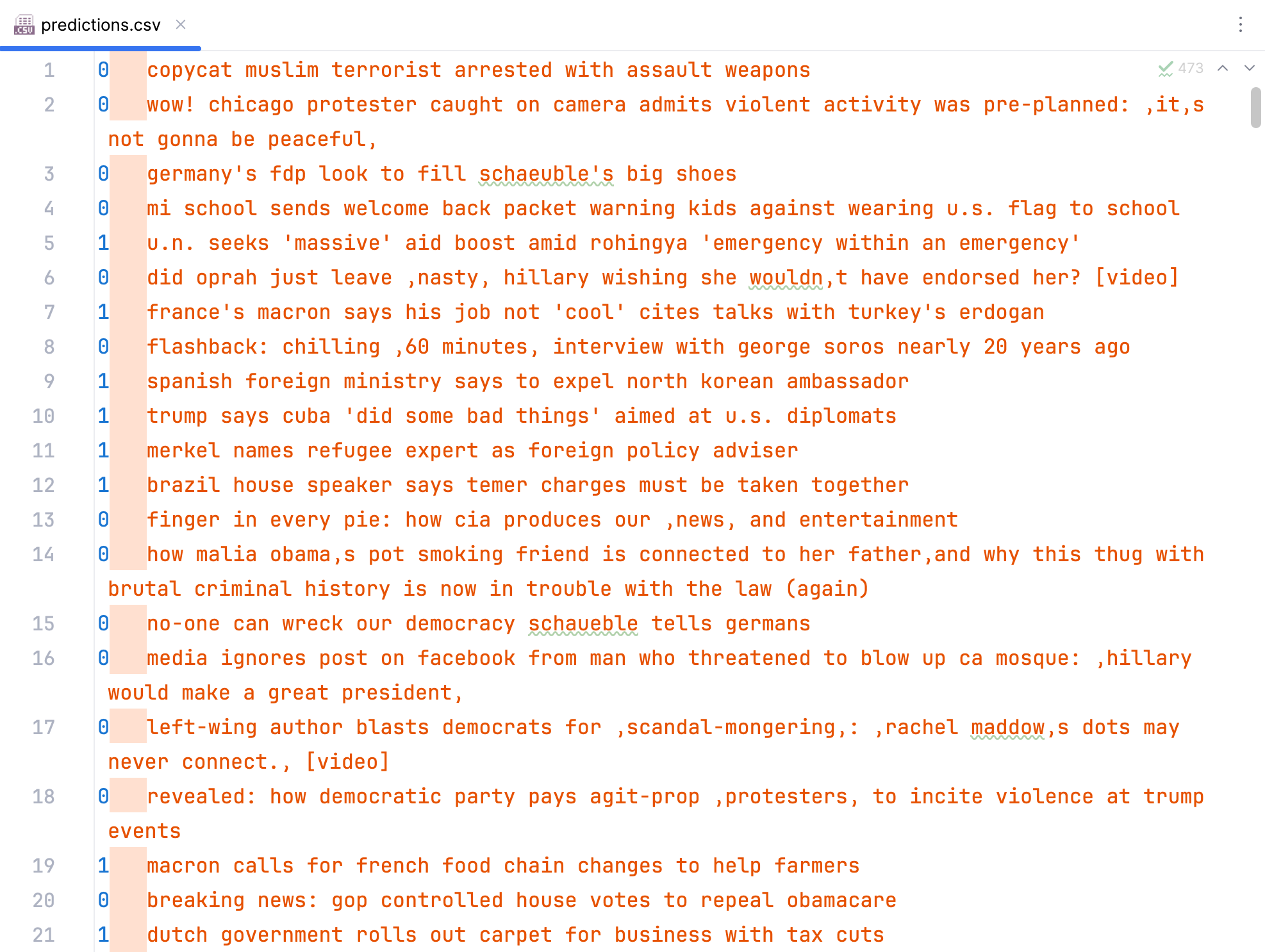
In one of the courses I teach, students have to train several predictive models to determine whether a set of headlines are real or "fake news". The models are trained on press headlines, some real, some fake.
They use a mix of classic and modern models, but no LLMs. Logistic regression, random forest, SVM... trained with BOW, TF-IDF, and embeddings.
These models, again, not very sophisticated and built by students, manage to identify fake news with 90%-95% accuracy on a Kaggle-like dataset.
The hypothesis
The dataset we use for the project was created in 2016-2017, during Trump's first term.
On the class discussion, one of the students asked me whether it would make sense to use a model trained on 2016 data to distinguish 2026 headlines.
My first thought was that the models would work equally well. But then I thought about data drift, and I believed that there would be some value in running the test, so I asked him to quickly re-run his models on the modern dataset.
It's an interesting hypothesis: can we run inference on a model trained on 2016 real/fake news against 2026 headlines?
In other words, has the way headlines are written changed over the last 10 years?
The result
I have to admit I didn't expect the results.
The 2016 model flags the vast majority of real 2026 headlines as fake.
What does this mean? Real news headlines from 2026 follow the same pattern as fake news headlines from 2016.
This does NOT mean that the media lies more —whether they do, this experiment doesn't test for that—, only that the syntax used to write headlines has changed.
It's quite surprising: if we traveled through time and handed a 2026 newspaper to a citizen of 2016, they'd be unable to tell whether what they were reading was true or false.
Incredible, right? Clickbait, catastrophism, misfortune, fury, and outrage have won.
Algorithmic social media pushed journalists towards clickbait
But why? I do have a hypothesis: News discovery via algorithmic social media has killed journalism.
The current model is broken: Journalists' salaries are paid by ads. Ad revenue depends on website visits. Visits depend on users clicking when they read a headline. Fake news headlines are designed to outrage the reader so they click. Fake news outlets take all the traffic and money away from journalism.
Journalists have no choice but to match the style of fake news and write increasingly catastrophist, surreal headlines to get those clicks.
I know many outlets have subscription options that help maintain journalistic integrity, but user acquisition still depends on headlines, and those are written according to the "post-truth playbook"
What a shame. Journalism is critical to a democratic society, and now they are slaves to companies which gatekeep media distribution via algorithms designed to behave like drugs.